



Can flex ducts be cleaned? Sometimes, but the answer depends on the duct’s construction, condition, and suitability for the proposed cleaning method. At The Duct Cleaners, an inspection can lead to cleaning some sections and recommending replacement of others.
Chris described two visits that show why. In Avery Ranch, he found intact, supported flex duct with dust and pet hair inside. In Allandale, he found a separating inner liner, a collapsed section, and insulation fibers exposed to the airstream.
The first inspection supported cleaning. On the second, he declined to brush the damaged flex runs.
Based on field accounts from Chris and Stacey, technicians at The Duct Cleaners.
Can flex ducts be cleaned? What the inspection must establish
Residential flex duct commonly has an inner air-carrying liner supported by a wire helix, with insulation and an outer jacket surrounding it. A problem with one layer may not be obvious from looking at another.
Chris looks inside the duct and checks the accessible exterior, supports, and connections. He wants to understand whether the material can tolerate the proposed work before putting a cleaning tool into it.
His assessment includes:
- The visible condition of the inner liner, including tears, brittleness, or separation.
- Any exposed insulation, loose material, or collapse within the air passage.
- The condition of the exterior insulation jacket and accessible supports.
- The size and length of the run and the available access.
- The connections at the room’s duct opening and the system’s distribution box, or plenum.
The manufacturer’s instructions and applicable cleaning standards also matter. An intact appearance alone does not establish that every brush or vacuum setting is suitable for that product.
NADCA’s flex-duct assessment discussion describes evaluating condition and available methods before deciding whether cleaning or replacement is appropriate. Its examples should not be treated as blanket approval to brush every residential flex duct.
Avery Ranch: cleaning an intact liner
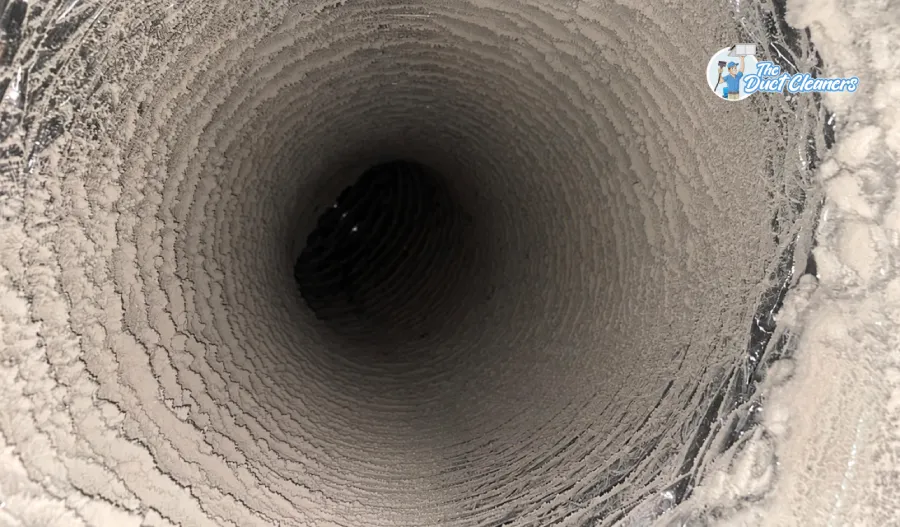
On a late-September visit in Avery Ranch, Chris inspected a home he estimated was about 12 years old. He described the flex duct as well supported, with an intact inner liner and an outer insulation jacket that had not been crushed.
The camera showed dust and some pet hair in the ridges. It did not show tears or exposed wire in the inspected sections.
“The inner liner was intact, the insulation jacket wasn’t crushed, and the runs were properly supported.”
— Chris, The Duct Cleaners
For this job, Chris reported using negative-air collection and a soft rotary brush at reduced speed. Negative-air collection means the collection equipment draws air and loosened debris toward removal rather than allowing the cleaning tool to scatter it through the system.
The follow-up footage showed the cleaned ridges. That was the documented result Chris described. The account does not establish an energy saving, a change in indoor particle counts, or a health outcome.
The useful lesson is the sequence: inspect the product and its condition, select a suitable method, then check the result. The equipment settings used on this particular job are not instructions for another system or a homeowner’s DIY project.
Allandale: declining to clean damaged runs
A couple of weeks later, Chris inspected an Allandale home with older flex duct that he understood to be original to a house built around 2003.
The camera showed sections where the inner liner was separating from the wire helix. One run had a collapsed liner, with insulation fibers visible inside the air passage.
Chris concluded that brushing those sections could worsen the damage and release more loose material.
“I told the homeowner we weren’t going to clean those runs.”
— Chris, The Duct Cleaners
He cleaned the metal trunk and returns and recommended replacement of the affected flex runs. Cleaning the metal sections did not repair the damaged liners.
A damaged liner is a different problem from dirt on an intact surface. Removing dust cannot restore a liner that is separating or has collapsed. The customer needed a clear record of the damaged sections and the work that remained.
The two inspections side by side
| Inspection detail | Avery Ranch | Allandale |
|---|---|---|
| Inner liner | Intact in the inspected sections | Separating from its support wire in places |
| Duct shape and support | Runs described as properly supported | A collapsed liner section was visible |
| Material inside | Dust and pet hair in the ridges | Exposed insulation fibers in the air passage |
| Decision | Clean using the selected method | Decline cleaning of damaged flex runs |
| Work reported | Negative-air collection and a soft brush at reduced speed | Metal trunk and returns cleaned; flex replacement recommended |
| Documented endpoint | Cleaned ridges in follow-up footage | Damaged runs excluded and replacement recommended |
Age helped Chris understand the systems, but the visible condition drove the different recommendations. These cases do not establish a universal age at which flex duct must be replaced.
What changes the equipment decision
Chris starts with liner condition. He then considers the run’s diameter, length, access, and connections.
“If the liner looks brittle or I see daylight through it on the camera, brushing is off the table.”
— Chris, The Duct Cleaners
He also described checking the connection at the boot, the fitting near the room opening, and at the plenum. A connection held by failing tape may come loose during work. That is a reason to inspect the connection and determine what correction is needed before proceeding.
A tool suitable for a sound metal section may be unsuitable for a particular flexible liner. NADCA’s guidance on cleaning equipment specifically cautions that overly aggressive methods can damage flex duct, ductboard, and fiberglass-lined ductwork.
For a homeowner comparing recommendations, ask the technician to connect the method to the inspection:
- What material and condition did you identify?
- Why is the proposed method appropriate for this product?
- How will loosened debris be collected?
- Which areas will remain inaccessible or untreated?
- What would make you stop the work?
Those answers help explain a proposal more clearly than the name of a machine alone.
The written scope homeowners should receive
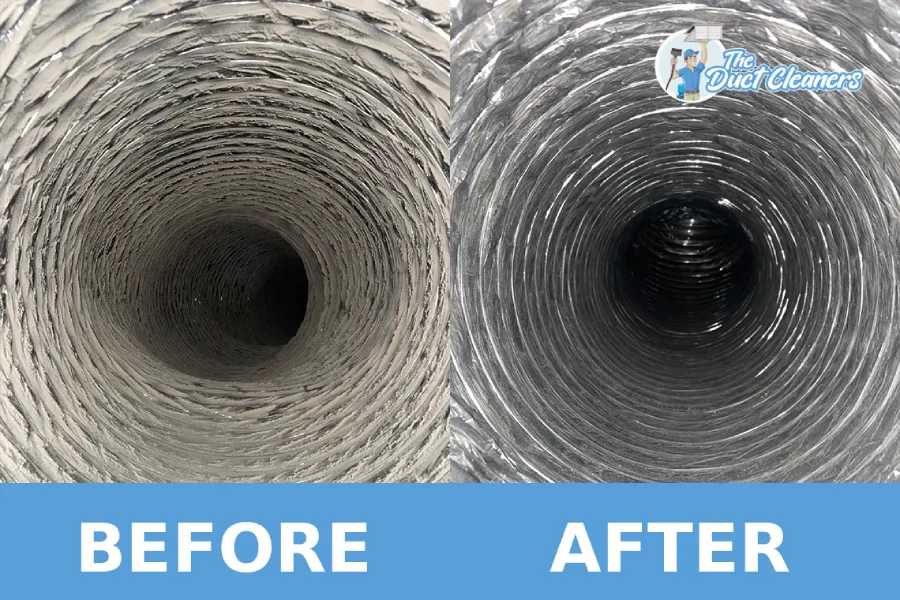
Stacey explains questionable duct condition by showing the camera footage. When possible, Stacey compares the damaged area with a sound section so the homeowner can see the difference.
“We put it in writing on the scope too: what we cleaned, what we didn’t, and why.”
— Stacey, The Duct Cleaners
For a mixed system like the Allandale home’s, the record should identify the sections included in the cleaning, the sections excluded, and the reason for each recommendation. Photos or video references make that information useful to the next contractor.
If replacement is recommended, ask for the affected runs to be identified and for the condition to be documented. A recommendation to replace one damaged run does not, by itself, establish that every run in the home needs replacement.
You can learn more about our general service on the Austin air duct cleaning page. The inspection determines the scope for your particular system.
Frequently asked questions
Can flex ducts be cleaned without damaging them?
Some can, when their condition and the manufacturer’s requirements support an appropriate method. An inspection should come first. The Avery Ranch account illustrates a job the technician considered suitable; the Allandale account illustrates why some runs should be excluded.
Does a soft brush make every flex-duct job suitable for cleaning?
No. A softer brush does not repair a brittle, torn, or separating liner, and it is not automatically compatible with every flex product. Tool selection must follow the assessment rather than replace it.
Should older flex ducts always be replaced?
The two cases here do not support an age-only rule. Chris considered age alongside the actual condition. Ask to see the damage or other finding behind a replacement recommendation and whether it affects specific sections or the whole system.
Can part of the system be cleaned while damaged flex is left out?
A limited scope may be appropriate following an assessment. On the Allandale visit, Chris reported cleaning the metal trunk and returns while excluding the damaged flex runs. Any remaining defect should be documented, and partial cleaning should not be represented as a complete repair of the system.
Can I use a dryer-vent brush inside my HVAC flex ducts?
Do not assume the tool or method is transferable. Dryer exhaust and HVAC air distribution are different systems. A brush that fits through an opening can still be unsuitable for the liner or its connections. Have the duct identified and assessed before selecting a cleaning method.
Start with a condition assessment
The Avery Ranch and Allandale visits led to different work because the inspections showed different conditions. That is the decision a useful assessment should explain.
If you are unsure whether your flex ducts can be cleaned, book an inspection with The Duct Cleaners. We can discuss what the inspection shows, which areas are suitable for cleaning, and what may need further attention.